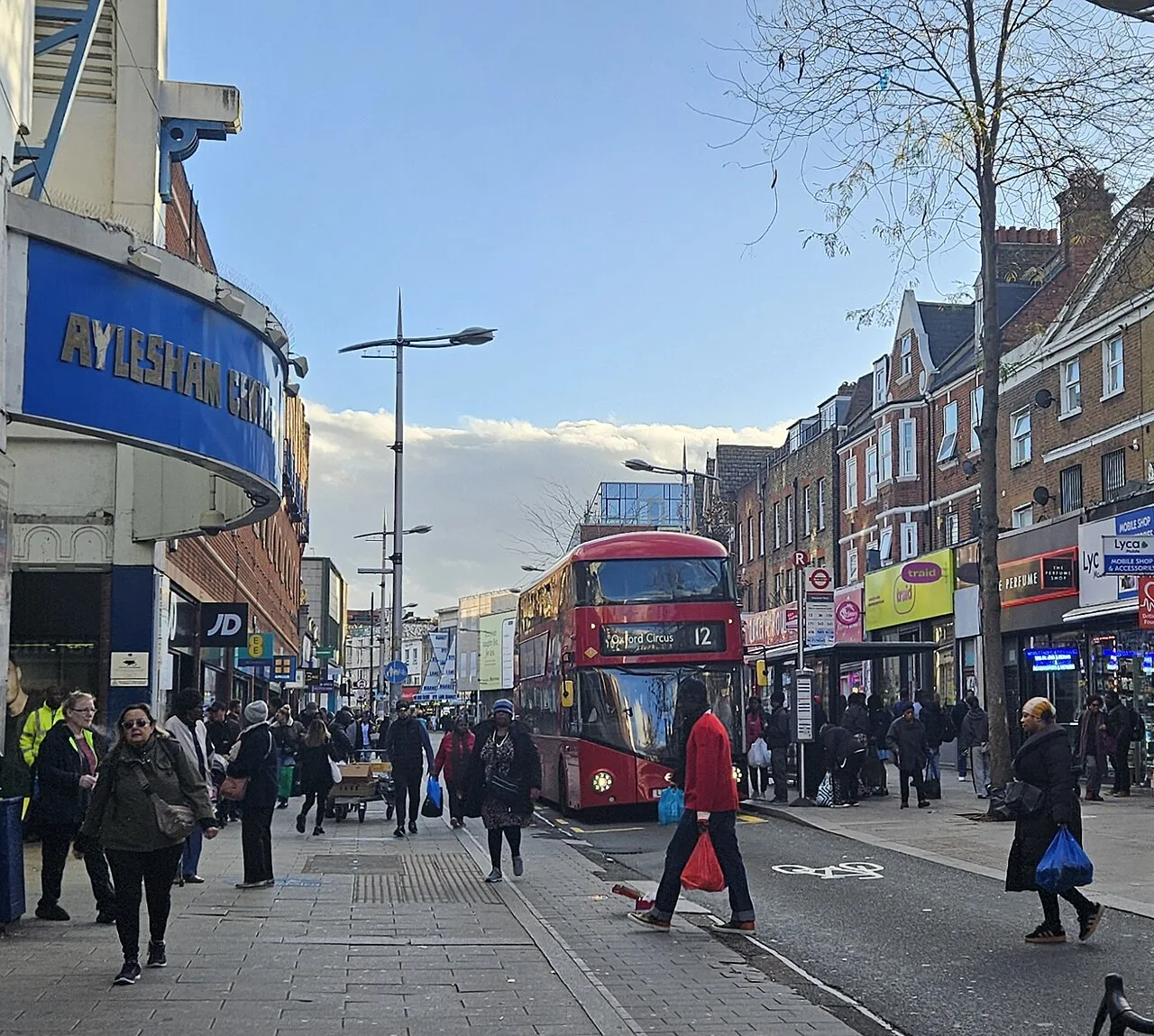

Southwark completed 1,004 homes last year against a target of 2,355, and claims 5.04 years of land. The Local Plan position, plus the Rye Lane and Abbey Street schemes now live.
Every planning decision in Dulwich, Peckham and Camberwell is made by Southwark Council against one document and one number: the Southwark Plan 2022, and a target of 2,355 new homes a year. The council is not hitting it, and the gap is widening. This page sets out where the plan stands, what the delivery figures actually say, and the two schemes worth watching right now.
The plan: adopted in 2022, being rewritten now
The Southwark Plan 2022 was adopted on 23 February 2022 and covers the period 2019 to 2036. It sets the policies every application here is judged against, including the borough’s affordable housing requirement of 25% social rented plus a further 10% intermediate, calculated by habitable room.
An updated Local Plan is in preparation. The council ran a call for sites in 2025 and a second one that closed on 19 April 2026, asking residents, businesses and landowners to put forward land for housing and employment. Sites that survive the assessment become site allocations in the new plan, and there will be a public consultation stage before anything is fixed. Nothing has been published for consultation yet, so the 2022 plan remains the document that decides applications.
Separately, the council and the Greater London Authority are preparing a new Old Kent Road Action Area Plan, which will govern the biggest regeneration corridor in the borough.
Delivery: the number that matters
The council publishes these figures itself.
| Year | Approved | Completed | Target | Completions as % of target |
|---|---|---|---|---|
| 2022 to 2023 | 2,282 | 1,475 | 2,355 | 63% |
| 2023 to 2024 | 2,299 | 1,327 | 2,355 | 56% |
| 2024 to 2025 | 1,468 | 1,004 | 2,355 | 43% |
Three things follow from that table.
The shortfall is getting worse, not better. Completions have fallen in each of the three years published, and last year’s 1,004 is 43% of the target.
The pipeline has thinned. Approvals held above 2,200 for two years and then dropped by more than 800 in 2024 to 2025. Approvals are not the same as completions and relate to different schemes, but they are the only forward indicator the council publishes, and it is pointing down.
Almost everything built is a flat. Of the 983 net homes completed in 2024 to 2025 that were split by type, 962 were flats and 21 were houses. New build accounted for 921 of them, with the rest coming from conversions, changes of use and extensions.
Non-self-contained supply, mainly student and older people’s accommodation counted at a conversion ratio, has collapsed alongside it: the self-contained equivalent fell from 775 net in 2022 to 2023 to 58 in 2024 to 2025.
Housing land supply: 5.04 years
National policy requires the council to keep a list of sites with at least five years of housing against its target. Southwark says it is meeting that, but narrowly.
For 2025 to 2030 the five-year housing need is 16,165 homes, and the council has identified land for 19,543 homes, which it calculates as 5.04 years of supply. That target already includes a 20% buffer applied because of the most recent Housing Delivery Test result, plus an adjustment for past under-delivery.
Five point zero four years is a margin of about two weeks. If completions keep falling, or a large allocated site drops out, the borough loses its five-year supply and the tilted balance in the National Planning Policy Framework starts to apply to appeals. That is the practical stake in every number above.
Affordable housing: better than the average year, worse than the policy
The Southwark Plan asks for 35% affordable housing by habitable room on major schemes, made up of 25% social rent and 10% intermediate. On gross approvals for major developments the council reports:
- 2022 to 2023: 52% affordable, 1,420 of 2,733 homes.
- 2023 to 2024: 27% affordable, 688 of 2,542.
- 2024 to 2025: 48% affordable, 911 of 1,909.
The tenure split matters as much as the headline. Of the 913 affordable homes approved in 2024 to 2025, 475 were social rent and 438 intermediate, which is close to a 50-50 split rather than the 25-to-10 ratio the policy asks for. Family-sized homes of three bedrooms or more made up 327 approvals, or 18% of major development, down from 22% two years earlier.
Two schemes to watch
269 to 275 Rye Lane, Peckham: 38 flats, now with a planning inspector
The application (24/AP/3834) is for the demolition of a vacant end-of-terrace building on the eastern side of Rye Lane and the construction of 38 flats and 152 square metres of commercial floorspace in two blocks around a courtyard: Block A of five storeys at 16.6 metres on the Rye Lane frontage, Block B of six storeys at 19.5 metres behind. The scheme is car-free apart from a single blue badge bay. The site adjoins the Rye Lane Peckham Conservation Area and includes a Protected Shopping Frontage at 275 Rye Lane.
It has not been decided by the council. The applicant appealed for non-determination, so it will be decided by the Secretary of State instead. A planning inspector has been appointed, and a hearing is listed for 25 August 2026 with a time estimate of one day. Written representations had to reach the council by 11 August 2026 to be passed to the inspector.
The interesting detail is why it took so long. The council’s own report says the delay came from “extensive negotiations to secure a voluntary affordable housing contribution of £1 million, equivalent to 8% of habitable rooms”, against a policy figure of 35%, along with redesign work on the Rye Lane frontage. Officers recommended approval, but on 10 August the committee resolved that it would have refused the scheme, on the quality of the flats and the absence of affordable housing, and that is now the council’s case to the inspector. Full detail in our story on the Rye Lane appeal hearing.
There is history on the site: a 2018 permission for 29 homes and 534 square metres of commercial space was granted and never built out.
177 Abbey Street, Bermondsey: 152 keyworker homes
Application 26/AP/0096 went to the Planning Committee (Major Applications) A on 7 July 2026 with an officer recommendation to grant. It proposes a tall building on the corner of Druid Street and Abbey Street delivering 152 homes, all of them affordable keyworker housing let at London Living Rent, plus a new 279 square metre community centre on the ground and first floors, and the pedestrianisation of Neckinger Street.
The council describes it as the pilot for its commitment to build 500 affordable keyworker homes in the borough, aimed at staff including its own teachers and social workers. The developer is Bouygues UK, which would also manage the tenancies for a 125-year lease. Any permission is subject to referral to the Mayor of London and a legal agreement, with a backstop of 9 December 2026 before officers can refuse it. The minutes of the 7 July meeting had not been published when we checked on 9 August.
How to follow or object to an application
- Search and comment on applications on Southwark’s planning register, which also carries the weekly list of newly validated applications.
- Committee papers, agendas and minutes are published on Southwark’s democracy site. Planning committees are usually live streamed on the council’s YouTube channel, and the public gallery is limited, so contact the constitutional officer named on the agenda if you want to attend in person.
- Southwark runs three planning committees: Major Applications A, Major Applications B and Smaller Applications, which despite the name takes major schemes as well.
Frequently asked questions
How many homes does Southwark have to build each year?
2,355 net additional homes a year under the Southwark Plan 2022, which is the figure the council uses in its own monitoring and its five-year land supply calculation.
Is Southwark meeting its housing target?
No. It completed 1,004 homes in 2024 to 2025, which is 43% of the target, and completions have fallen in each of the three years published. It does still claim a five-year land supply, at 5.04 years, but that figure already carries a 20% buffer imposed because of its Housing Delivery Test result.
When is the new Southwark Local Plan coming?
There is no adopted date yet. The council is at the evidence-gathering stage: it ran calls for sites in 2025 and again in 2026, the second closing on 19 April 2026, and site allocations will go out for public consultation before the plan is examined. Until then the Southwark Plan 2022 decides applications.
What is happening at 269 to 275 Rye Lane?
A 38-flat scheme that the council never determined. The applicant appealed for non-determination, so a planning inspector will decide it at a hearing on 25 August 2026. Officers recommended approval, but the Planning Committee resolved on 10 August that it would have refused, so the council will ask the inspector to dismiss the appeal.
Where do I object to a planning application in Dulwich?
Through Southwark’s planning register, within the consultation period shown on the application record. For an application that has gone to appeal, representations go to the council first and are forwarded to the Planning Inspectorate.
Related
- Dulwich house prices: what the borough’s flat-heavy supply does to the price of a house here.
- Roadworks, parking and travel in Dulwich: the Old Kent Road works are the visible end of the regeneration described above.
- Things to do in Dulwich: Rye Lane is also the address of the cinema, the art space and the car park roof.
Sources
- Southwark Council Southwark Plan 2022 for the adoption date, plan period and policy framework, and call for sites 2026 for the Local Plan update position.
- Southwark Council housing monitoring: 5-year housing land supply, permissions and delivery of self-contained homes, approvals and delivery of affordable homes, family housing, types of development and non-self-contained delivery.
- Planning Committee (Smaller Applications), 10 August 2026, officer report on 269 to 275 Rye Lane and 1A Philip Walk.
- Planning Committee (Major Applications) A, 7 July 2026, officer report on 177 Abbey Street, SE1 2AN.
Committee outcomes and appeal decisions change these positions. Check the council’s planning register and democracy site for the current status of any application named here.
Have your say