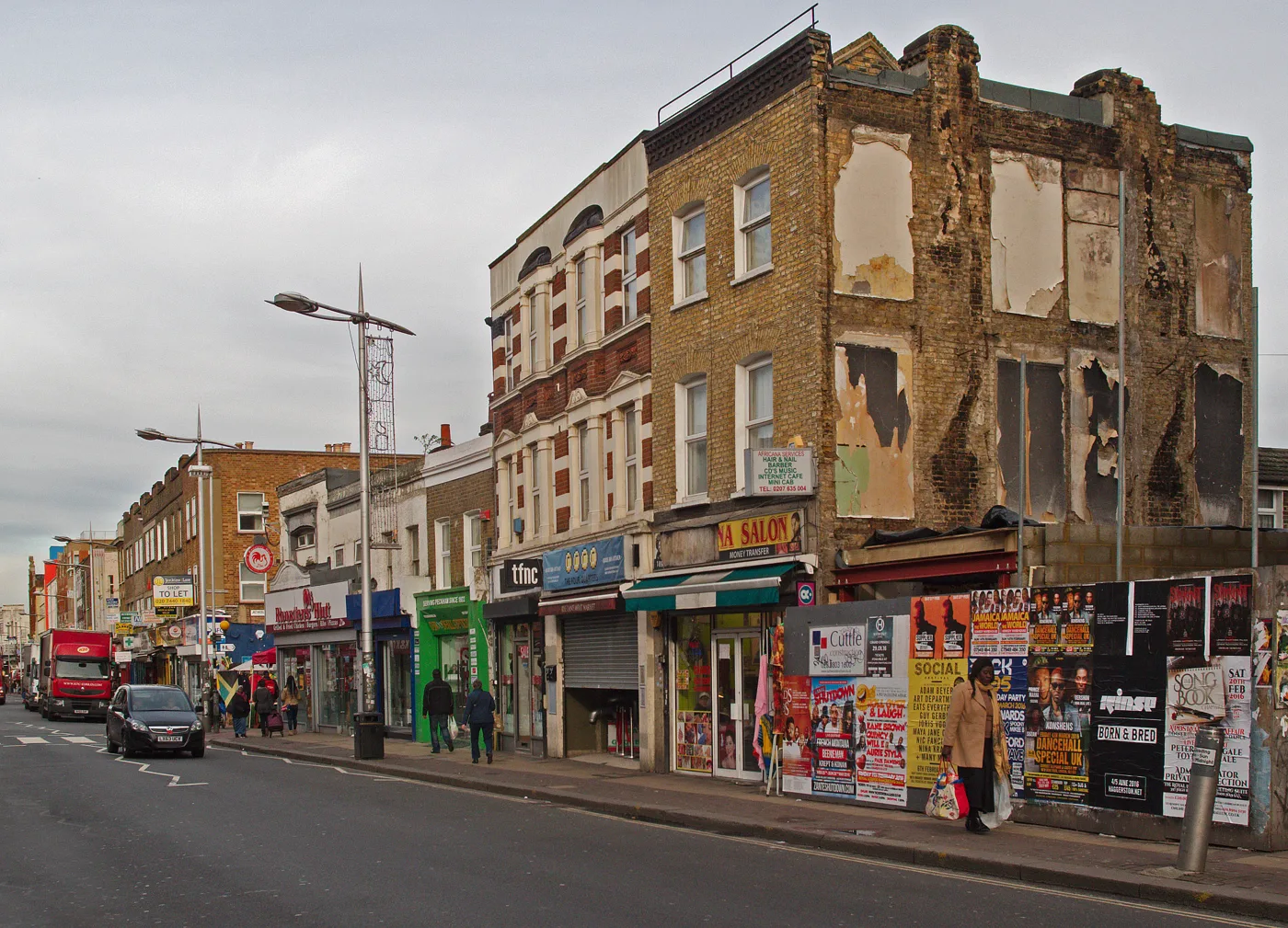

Southwark's committee has told an inspector it would have refused 38 flats at 269 to 275 Rye Lane, against its officers' advice. Public hearing 25 August, 10am.
Southwark’s Planning Committee has told a government inspector that it would have refused a scheme for 38 flats and a shop unit at 269 to 275 Rye Lane and 1A Philip Walk, Peckham, overturning the recommendation of its own planning officers. The decision now rests with a planning inspector, who will hear the case in public at 10am on Tuesday 25 August at the council’s offices at 160 Tooley Street.
The committee’s position is set out in the council’s statement of case, dated 11 August and published on the planning register on 13 August. It records that on 10 August 2026 the Planning Committee (Smaller Applications) “resolved that, had it been in a position to determine the application, it would have refused planning permission”, and it asks the inspector to dismiss the appeal.
That is a reversal of the paper the committee had in front of it. The officer report for the same meeting recommended that members “endorse the officer recommendation that would have been to grant planning permission”, subject to conditions and a legal agreement, and concluded that the scheme was “in general compliance with the development plan, when viewed as a whole”.
Why an inspector is deciding a Peckham application
The application, reference 24/AP/3834, was received on 30 December 2024 and validated on 30 January 2025. Its statutory decision deadline was 31 March 2026 and no further extension was agreed. The applicant, The Third Quarter (Rosebery Avenue) Limited, then appealed to the Planning Inspectorate for non-determination, which takes the decision out of the council’s hands altogether. The council’s register lists it as APPEAL/26/0028, an informal hearing, status “in progress”; the appeal form on the register is dated 1 June 2026 and the Inspectorate’s start letter 30 June.
The applicant’s own statement of case says officers had “confirmed full support at Officer level for the proposals”, but that the committee date “has been indefinitely delayed”, and that “in light of the political uncertainty in the wake of the May 2026 local elections” it chose to appeal rather than wait.
The officer report gives the council’s side of that delay: “extensive negotiations to secure a voluntary affordable housing contribution of £1 million (equivalent to 8% of habitable rooms)” and a run of amendments to the Rye Lane frontage, cycle parking, play space and flat layouts.
What is proposed
The site is a 1,468 square metre plot on the eastern side of Rye Lane, bounded by Co-operative House at 259 Rye Lane to the north and industrial units on Philip Walk to the east. It sits just outside, and in the setting of, the Rye Lane Peckham Conservation Area. A laundrette traded there until the previous permission was granted; the buildings were demolished in August 2021 and the plot has been vacant since.
The scheme is two blocks around a courtyard:
- Block A on the Rye Lane frontage, five storeys, 16.6 metres, with a 152 square metre commercial unit at ground floor.
- Block B at the rear, six storeys, 19.5 metres.
- 38 flats: 14 one-bed, 17 two-bed and 7 three-bed, of which 5 are wheelchair-accessible.
- Car-free apart from one blue badge bay on Philip Walk.
There is an earlier permission on the plot, 16/AP/1896, granted in August 2018 for 29 homes and 534 square metres of commercial space. Both sides agree in the statement of common ground that demolition in August 2021 lawfully implemented that consent, so it “remains extant”: in other words, the 29-home scheme could still be built whatever the inspector decides.
The two reasons the council will argue
The council’s putative reasons for refusal come down to two things.
1. Quality of the flats. The council says the scheme “would fail to provide a satisfactory standard of residential accommodation” and singles out the wheelchair-accessible units. Its statement points to single-aspect flats on the noisy Rye Lane frontage (units A03, A07 and A11 among them) that would need windows kept shut and rely on mechanical ventilation; extensive obscure glazing; “internal winter gardens in place of external private amenity space”; habitable rooms that miss the BRE daylight targets; five wheelchair units (A03, A05, A07, A09 and A11) below the minimum floorspace in Southwark Plan policy P8; and no second lift serving wheelchair homes above ground floor. The officer report’s own figures are that 11 of the 38 units (28.9%) are single aspect, and that 94 of 107 rooms assessed (88%) met the daylight criterion, with 9 of the 13 failures in Block A on the street.
2. No affordable housing. Southwark policy asks for 35% affordable housing, subject to viability. The applicant’s viability assessment put the scheme in deficit by £6,167,429; the council’s independent reviewer, JJ Viability, found it £4,316,016 more viable than that but still £1,851,361 in deficit, and concluded a nil contribution was the maximum viable. Officers had accepted that, with a late-stage review clause. The committee did not: the council’s case is that with more than 18,000 households on the housing waiting list, an assessed need for 2,077 social rented and intermediate homes a year, and only 4.53 years of housing land supply against a five-year requirement, a scheme with no affordable housing “would result in an unacceptable loss of opportunity”.
The £1 million payment in lieu the developer offered during the application is the awkward piece in the middle. The officer report says the offer “has now been withdrawn by the applicant” but “remains in blue pencil in the draft s106 agreement”, and asks the inspector to consider whether it is needed. The statement of common ground lists it among the heads of terms discussed, but records the appellant’s position that such a contribution “is not necessary to make the development acceptable in planning terms” because the scheme was tested as unable to support any affordable housing.
The developer argues the reverse of the committee on the planning balance: that with the council unable to show a five-year land supply, the “tilted balance” in paragraph 11d of the National Planning Policy Framework applies and the benefits of 38 homes on a brownfield site “significantly and demonstrably outweigh any adverse impacts”. The council disagrees.
Who objected
The council consulted every address within 100 metres, posted site notices and a press notice. It received 19 letters: 18 objections and one in support, many of them from addresses at Co-operative House next door. The objections, as summarised in the officer report, were about height and massing, loss of daylight and sunlight to flats and communal areas in Co-operative House, overlooking, noise reverberating in the courtyard, the lack of affordable housing, and doubts that a new commercial unit on that stretch would find a tenant. The single supporter backed redevelopment of a brownfield plot at that scale.
What it means for you
- The hearing is public. It starts at 10am on Tuesday 25 August 2026 in the ground floor committee rooms at 160 Tooley Street, SE1 2QH, with a time estimate of one day. The inspector’s pre-hearing note says the discussion will focus on living conditions for future residents and affordable housing, and that “any party who so wishes will be given an opportunity to speak”. A site visit follows the hearing.
- The written deadline has passed. Representations had to reach the council by 11 August to be forwarded to the inspector. If you want to be heard, going on the day is the remaining route.
- The decision is the inspector’s, not the council’s. The council’s committee vote is now its case, not a decision notice. The written decision will be published on the appeal record on the planning register after the hearing; there is no fixed date.
- The plot will not stay a plot for lack of permission. The 2018 consent for 29 homes is agreed by both sides to be live, so a dismissal would not stop building on the site, only this version of it.
We track this and other Southwark schemes on our Dulwich planning news page, which also explains how to search and comment on applications.
Key dates
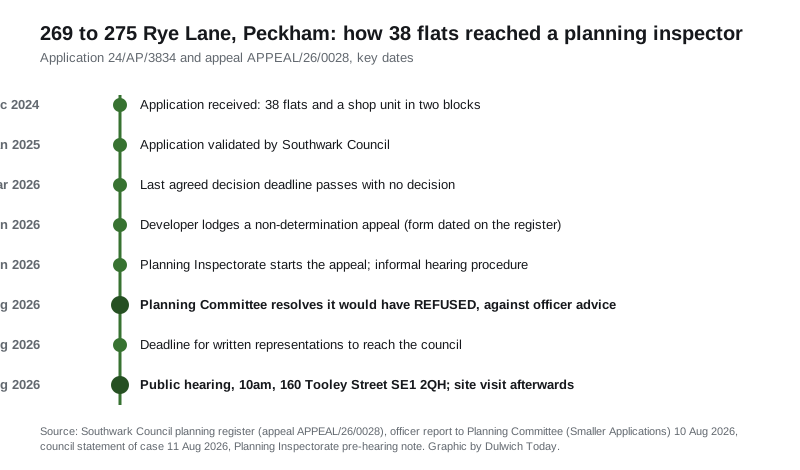
Sources: Southwark Council planning register, appeal APPEAL/26/0028; officer report to Planning Committee (Smaller Applications), 10 August 2026; council statement of case dated 11 August 2026; Planning Inspectorate pre-hearing note.
Have your say