Southwark's Executive decides on 15 September whether to scrap priority stars, drop working in the borough and re-band every one of 22,000 applicants.
Southwark is about to rewrite the rules on who gets a council home, for the first time since 2013. The decision goes to the council’s Executive on Tuesday 15 September, and if it is approved, every one of the more than 22,000 households on the housing register will be moved into a new priority band.
Three changes matter most to people already on the list:
- Priority stars go. Working, volunteering and the Good Tenant Award will no longer earn extra priority within a band.
- Working in the borough stops being an automatic qualification to join the register, apart from where the law requires it.
- The four bands become five, lettered A to E, with a new bottom band for households assessed as having low or no housing need.
The papers are the Housing Allocations Scheme Review report and its appendices, published for the meeting by Councillor Reginald Popoola, the Executive Member for Council Homes.
Why now
The council’s own answer is partly the regulator. Southwark received a C3 grading from the Regulator of Social Housing in November 2024, and the report says the Regulator “was highly critical of the lack of an updated housing allocations scheme”. Southwark is still on the Gradings Under Review list, and the report notes the Regulator has the power to downgrade the council to a C4 or start enforcement action.
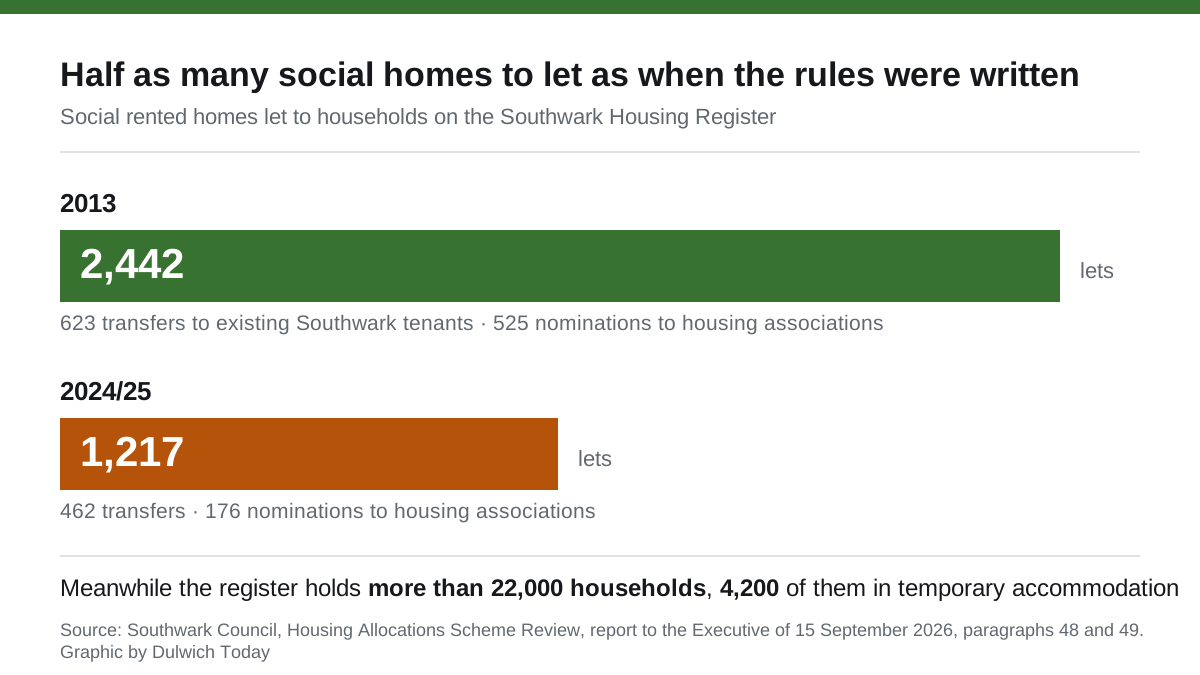
The other half of the answer is the arithmetic in the chart above. The register has grown past 22,000 households, with 4,200 in temporary accommodation, while the supply of homes to let it into has halved:
- 2013: 2,442 social rented homes let to register households, including 623 transfers and 525 housing association nominations.
- 2024/25: 1,217 lets, including 462 transfers and 176 nominations.
What changes, in detail
| Now (2013 scheme) | Proposed (2026 scheme) |
|---|---|
| Four bands, 1 to 4 | Five bands, A to E |
| Priority stars for working or volunteering, plus a Good Tenant Award | No priority for anything outside housing need |
| Working in Southwark is an automatic qualification | Removed, except where Right to Move guidance requires it |
| Care leavers usually in Band 2 | Southwark care leavers in Band A, time limited |
| Same-sex siblings expected to share to age 15 | Share to age 20 unless there are medical or welfare grounds |
| Three refusals can mean band demotion | Three refusals in 12 months means 12-month suspension, not demotion |
| No routine annual review | Applicants must confirm their circumstances every year to stay on the register |
| New council homes: up to 50% to existing tenants | Site by site, anywhere from 0% to 100% |
Homeless households owed the main duty go into Band C. Homeless households not owed a duty go into Band D, a band that exists so the council can give them the reasonable preference the Housing Act requires. Applicants on Southwark’s Housing First programme and eligible armed forces applicants go into Band A.
Overcrowding is being reassessed on a different basis: statutory overcrowding and the council’s bedroom standard, rather than the Local Housing Allowance bedroom criteria used now. The test that could reduce priority where overcrowding was caused by a “deliberate act” is being dropped.
Band E, and the one thing the consultation changed
Band E is the new bottom band, for households with low or no housing need, including council tenants who want to move but have no assessed need.
The draft scheme proposed that Band E applicants should not be allowed to bid for advertised homes at all. Most respondents disagreed, and the council has dropped that. Band E applicants will be able to bid, while being told plainly that they are unlikely to be rehoused.
One wrinkle for anyone reading the papers: the schedule of changes at Appendix D still describes Band E as having “no bidding rights”, which the main report and the recommendations contradict. The recommendation members are being asked to approve is the one that allows bidding.
What the consultation said
The council consulted for 12 weeks from 10 March 2025. It reports:
- more than 600 responses through its online engagement site
- 482 responses by email, of which 480 used a substantially identical template coordinated by Housing Action Southwark and Lambeth
- 60.7% agreed with removing working in the borough as an automatic qualification
- just under half agreed with removing non-housing priority
- 54.2% agreed with limiting the number of offers made to each applicant
- almost three quarters agreed with the annual confirmation requirement
Housing Action Southwark and Lambeth’s response argued that local connection rules should be relaxed rather than tightened, and that applicants in rent arrears because of benefit problems should be supported rather than penalised. The council says there are safeguards in the new scheme for both.
What it means for you
If you are on the Southwark Housing Register. You do not need to reapply. The council says the migration to the new bands will be largely automated, that every applicant will be notified of their new band, that everyone will be invited to supply extra information about their circumstances, and that everyone will be told of their right to request a review of the new decision.
If your priority currently rests on a star. That is the group most exposed by this. Priority stars and the Good Tenant Award disappear entirely, so a household whose position depends on working, volunteering or an unblemished tenancy will be ranked purely on assessed housing need.
If you work in Southwark but live elsewhere. Working in the borough will no longer qualify you on its own. The report says safeguards remain for people who need to move to Southwark for work where failure to do so would cause severe hardship.
If you are a council tenant wanting a move. Tenants with no assessed housing need are the other group heading for Band E. Downsizing is the exception: the new scheme deliberately widens what under-occupying households can bid for.
If you want to be ready. Expect a request to confirm your circumstances every year from now on. Failing to answer it will be enough to come off the register.
When it starts
The report says the scheme “will go live shortly following Executive approval”, alongside a new choice-based lettings system that has to be switched on at the same time. A separate Management Transfer Policy takes urgent management moves out of the main scheme.
The council is asking for up to £143,000 to pay for temporary capacity equivalent to five officers for six months, to handle the increase in enquiries, statutory review requests and casework it expects between July and December 2026. It has also committed to reviewing the new scheme after 12 months of operation.
Sources
- Report: Housing Allocations Scheme Review, Southwark Council, for the Executive of 15 September 2026, for the recommendations, the register and lettings figures (paragraphs 48 and 49), the Regulator’s C3 grading, the consultation results, the migration process and the £143,000 implementation cost.
- Appendix D: Housing Allocations Scheme 2026 Scope of Changes, for the point by point comparison with the 2013 scheme.
- Executive agenda, Tuesday 15 September 2026, for the meeting, the full scheme document at Appendix A, the consultation results report at Appendix B and the Management Transfer Policy at Appendix C.
Related
- Dulwich council tax bands: what Southwark charges, band by band, against Lambeth over the boundary.
- Dulwich planning news: what is being built across the borough.
- Dulwich house prices: area by area, from Land Registry sales.
Have your say