
Cars with three or more unpaid parking tickets could be clamped even when legally parked, if councillors agree on 18 November. Evaders cost £2.1m a year.
Southwark Council wants the power to clamp and tow cars that owe three or more unpaid parking tickets, even when they are parked legally. Councillors vote on it at Council Assembly on Wednesday 18 November.
The proposal is in a report to the meeting published on 6 November. It would adopt Part 5 of the London Local Authorities and Transport for London Act 2008, which targets what the law calls “persistent evaders”.
Who counts as a persistent evader
The report defines a persistent evader as a vehicle with three or more open, unpaid penalty charge notices (PCNs), where either:
- the tickets have gone unpaid as far as the charge certificate stage, or
- there is no registered keeper at the DVLA, so the tickets cannot be enforced.
What changes
At the moment the council can only clamp or remove one of these vehicles when it finds it parked illegally. The report says that limits the effect. Fewer than 10% of persistent evader vehicles are clamped.
Under the new powers:
- a persistent evader vehicle can be clamped and then removed even when it is legally parked
- if the owner is known, every outstanding penalty owed to the council has to be paid, or a payment plan agreed, before the vehicle is released
- if the owner is unknown, the vehicle is released only when the keeper proves who they are, so the tickets can be chased
- a keeper who disputes the tickets can pay a bond to get the vehicle back while they challenge them, with the usual right of appeal to the parking adjudicator
Blue badge holders keep the exemptions in the existing enforcement protocol, the report says.
The numbers
Southwark issued 365,147 PCNs in 2025/26, and around 72% were paid. Of the 28% left unpaid, the report says 10% relate to persistent evaders. It puts the lost income at about £2.1 million a year.
The council’s monthly tracker shows how few of those vehicles it reaches now:
| Month | Vehicles with 3+ unpaid tickets | Tickets issued to them | Removed | Clamped |
|---|---|---|---|---|
| June 2026 | 383 | 1,807 | 40 | 24 |
| July 2026 | 408 | 1,911 | 34 | 26 |
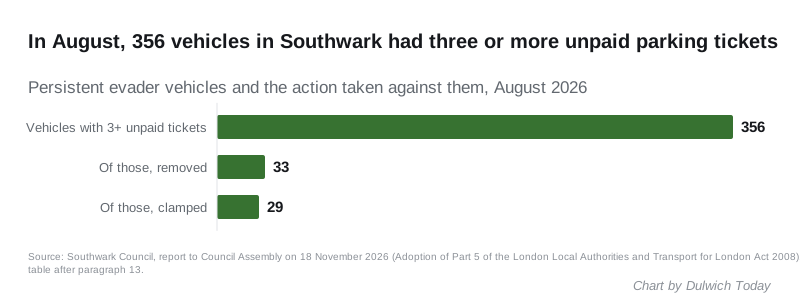
| August 2026 | 356 | 1,712 | 33 | 29 |
The report links the rise in persistent evaders to the council issuing more tickets, through more CCTV enforcement and more civil enforcement officers. It also says the powers could help find cloned vehicles, cars carrying someone else’s number plates, more quickly.
When it would start
Not straight away. If the Assembly agrees, a council officer sets an “appointed day”, which must be at least one month after a notice appears in the London Gazette. Southwark would run it as a one-year pilot, against its own persistent evaders only, and then decide whether to keep it.
The enforcement would be carried out by APCOA, the council’s parking contractor, within the existing budget. London Councils approved a code of practice for the powers in September 2026, and Southwark says it will follow it.
What it means for you
- If you have a parking ticket you have not dealt with, pay it or challenge it now. Three unpaid tickets that reach the charge certificate stage would make your car eligible, wherever it is parked.
- If your car is clamped under the new powers, you would have to clear every outstanding penalty owed to Southwark, or agree a payment plan, to get it back. You can pay a bond and appeal if you think the tickets are wrong.
- If you have bought a used car, check that the DVLA has you as the registered keeper. Vehicles with no registered keeper are one of the two groups targeted.
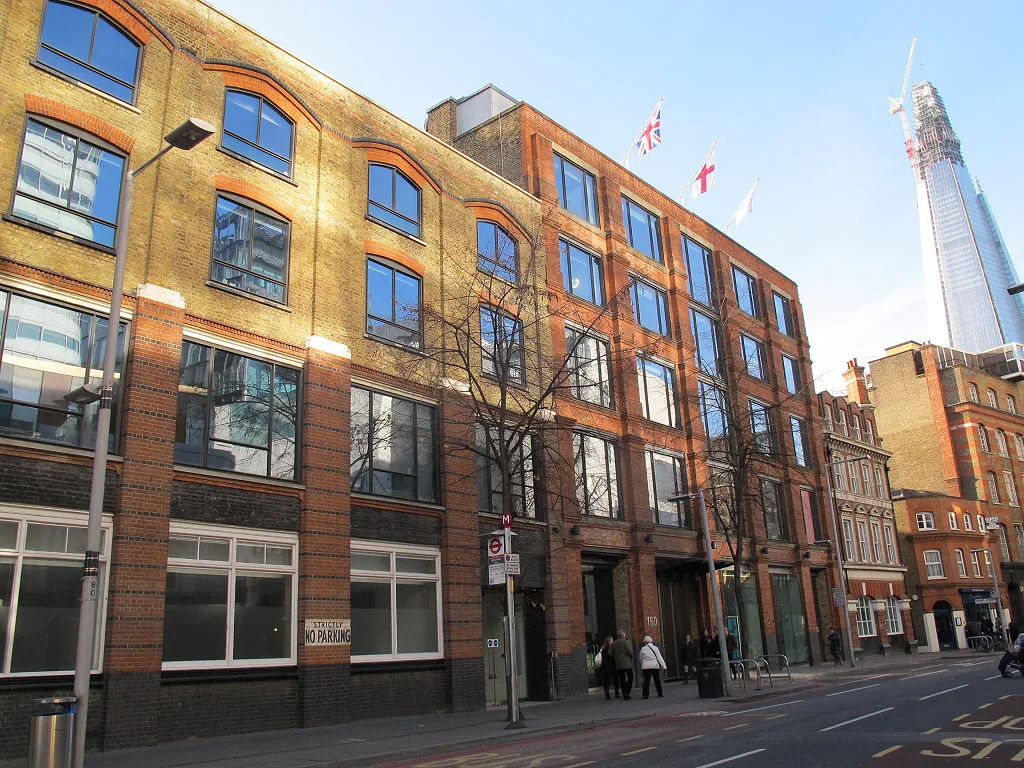
- To follow the debate, the meeting is at 7pm on Wednesday 18 November at 160 Tooley Street. The agenda has the papers.
Our parking in Dulwich page has the zones, hours and car park charges.
Sources
- Report: Adoption of Part 5 of the London Local Authorities and Transport for London Act 2008, Southwark Council, to Council Assembly on 18 November 2026, for the definitions, the powers, the 2025/26 ticket figures and the monthly tracker.
- Council Assembly, 18 November 2026: agenda, published 6 November 2026, for the time and venue.
Have your say