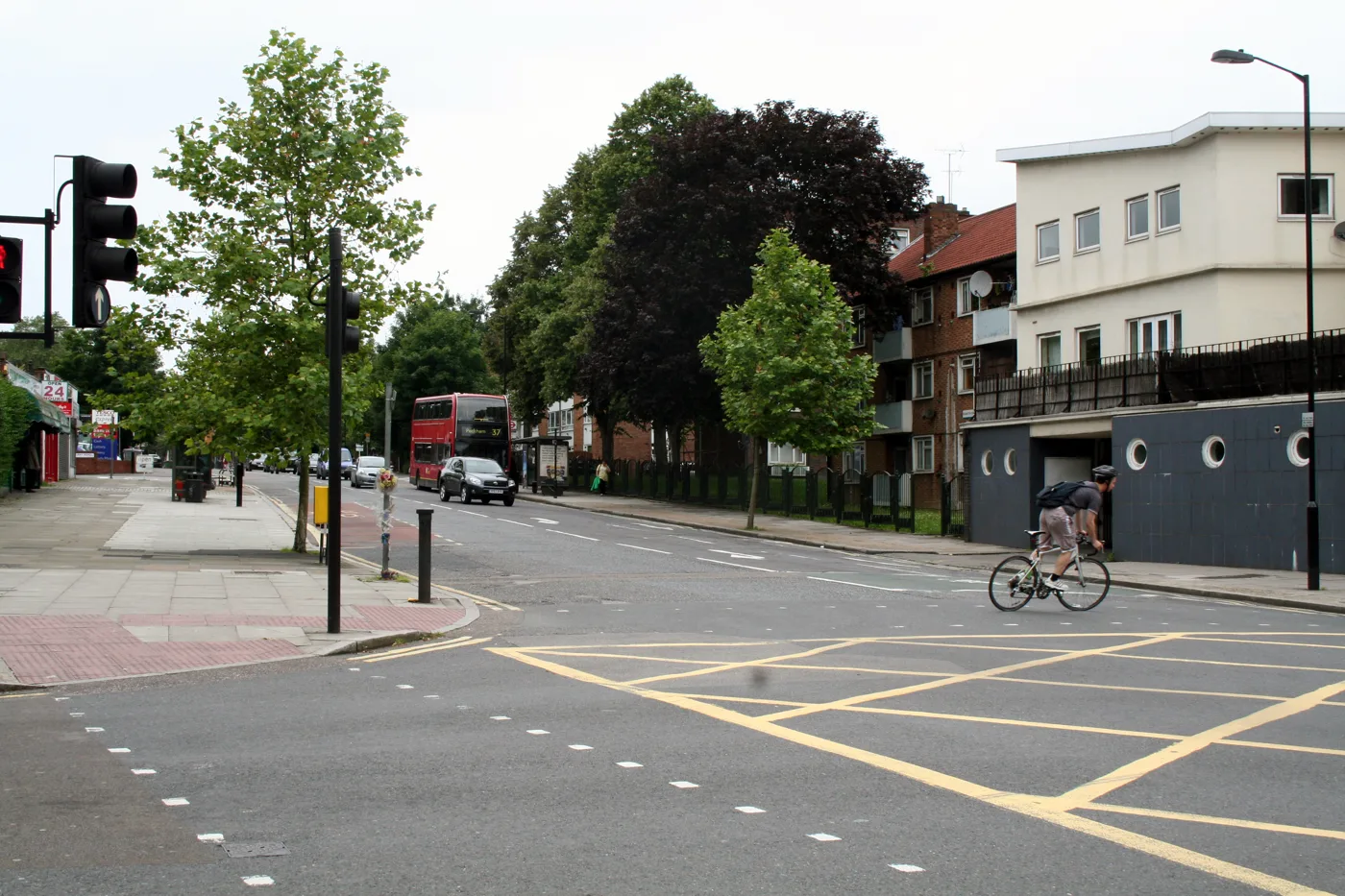

Southwark's £2.5m gyratory scheme would close Peckham Rye East to all but buses and bikes. The decision is due from 15 September, objections in October.
Southwark Council is about to sign off a £2.5m rebuild of the Peckham Rye gyratory that would close the east side of the Common to everything except buses and cyclists. The decision sits with the leader of the council and is due not before Tuesday 15 September.
The scheme covers Rye Lane, Copeland Road, Peckham Rye, Nigel Road, Philip Walk, Scylla Road and East Dulwich Road. It is funded by Transport for London through the council’s Local Implementation Plan grant, and the council’s own report puts the cost of the design stage at £98,000 and the full design and build at £2.5m.
The main changes are:
- a bus gate on Peckham Rye East, closing the road to traffic except buses and cyclists
- a new northbound bus lane on Rye Lane, extended up to the Copeland Road junction
- Scylla Road closed to motor traffic, extending the school street outside Rye Oak Primary
- new segregated cycle track on Rye Lane, Peckham Rye and East Dulwich Road, as part of Cycleway C35
- new zebra crossings and raised tables on Rye Lane, Nigel Road, Philip Walk, Peckham Rye and six other streets
- the service road outside the Nags Head pedestrianised, to take a relocated bus stop
- changes to parking and loading restrictions on every street in the scheme
The bus gate split the consultation down the middle
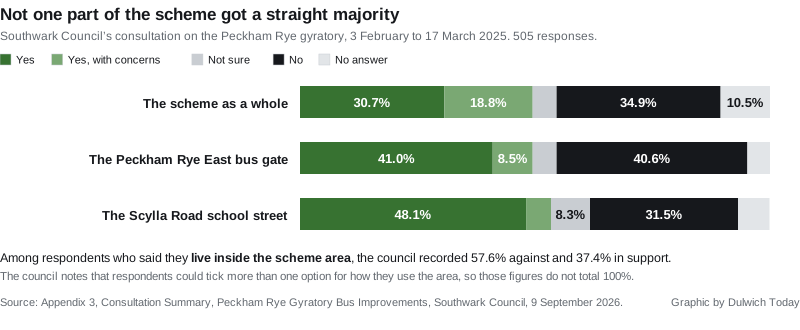
This is the part of the scheme people argued about, and the vote on it was almost exactly even. Asked whether they supported a bus gate on Peckham Rye East, 41.0% of respondents said yes and 40.6% said no. A further 8.5% said yes with concerns.
The council’s report leads with a different number. It says there was “majority support for the scheme (49.5% ‘yes’ or ‘yes with concerns’ vs 34.9% ‘no’ out of 505 responses)”. That 49.5% is short of half. The rest of the sample was 5.1% unsure and 10.5% who did not answer the question at all.
The objection is about where the traffic goes instead. The council’s own summary records that the most common theme in the free-text comments was concern about increased traffic congestion, raised 76 times, followed by support for the cycling improvements (49 mentions) and worry about traffic displacement (25).
On the bus gate question specifically, congestion came up 69 times and displacement 28. Respondents named the streets they expected it to land on: the west side of Peckham Rye, and East Dulwich Road.
The people who live there were against it
Southwark cross-tabulated support against how respondents described themselves. People who work in the area, travel through it or visit it were in favour.
Among those who said they live inside the scheme area, 57.6% were against and 37.4% in support, with 10.1% unsure. The council notes that respondents could tick more than one option for how they use the area, so the figures do not total 100%. It is the only group in the survey that came out against.
Support also tracked how people get around. The report records more support from those travelling on foot, by wheelchair or mobility aid, by bus or by bike, and less from car and van drivers.
The same bus gate was dropped once before
The council tried this in 2020. Peckham Rye went into Batch 4 of Southwark’s Covid-era Streetspace programme, and the decision to proceed was taken on 19 October 2020.
The segregated cycle lane and an informal crossing went in. The rest did not. The council’s report says the road closures on Scylla Road and Whorlton Road, and the bus gate between Nunhead Crescent and Nunhead Lane, were not installed because the permits did not come through until late November 2020.
By then, in the report’s words, “significant opposition to the scheme had been raised by the public and local Ward Councillors, concerned about the effect of displaced traffic”. On 16 December 2020 the cabinet member instructed officers not to finish the scheme. The cycle lanes were consulted on separately in 2021 and made permanent.
Six years on, the bus gate is back, on a road the council says is one of the busiest bike and bus corridors in the borough.
Why the council says the gyratory needs work
The report sets out what the Local Implementation Plan flagged about the area: a high number of collisions, inadequate or absent cycling facilities, a poor walking environment, no bus priority, and traffic signals needing safety upgrades.
There are two primary schools inside the scheme area, Rye Oak and Bellenden, plus three nurseries. The council says the footways are narrow and uneven despite the footfall, and that existing cycle provision is “stop-start, with fragmented short sections of cycle lanes on Peckham Rye and Rye Lane”.
What happens next, and when you can object
Approval on Tuesday is not the end of it. The leader is being asked to approve the layout and then instruct officers to run the statutory consultation on the traffic orders, which is the formal stage at which objections carry legal weight.
| Stage | When |
|---|---|
| Decision by the leader of the council | Not before 15 September 2026 |
| Detailed design | September to October 2026 |
| Statutory consultation on the traffic orders | October 2026 |
| Report back to the leader if objections are received | December 2026 |
| Mobilisation and pre-construction | Early 2027 |
| Construction | Spring 2027 |
If anyone objects during the statutory consultation and does not withdraw it, officers must bring a further report back to the leader for determination. If nobody objects, the head of highways can make the orders under delegated authority. The report also asks for authority to hold a public inquiry into the traffic orders if officers think it expedient.
What it means for you
- If you drive round the gyratory. The bus gate on Peckham Rye East is the change to plan for. Nothing happens before spring 2027, and the layout can still change at detailed design.
- If you object. October is the moment, not this week. A formal objection at the statutory consultation stage forces the decision back to the leader. Watch for the traffic order notices; we list them on our roadworks and travel page.
- If you have a blue badge. The council says badge holders can pass through the proposed road closures if they sign up to the Southwark digital parking permit scheme. It notes there was confusion about this during the consultation.
- If you park on these streets. Parking and loading restrictions change on every road in the scheme, and two bays go on the west side of the gyratory for the bus lane. Current zone hours are on our parking in Dulwich page.
- If you run a business on Rye Lane. The council carried out kerbside activity surveys and door-to-door business visits, and says most of the parking it is removing is very short stay. Loading dialogue continues into detailed design.
Sources
- Report: Peckham Rye Gyratory Bus Improvements, Southwark Council, dated 9 September 2026, for the recommendations, Table 1 of measures, the £98,000 and £2.5m costs, the TfL funding, the timetable and the 2020 history.
- Appendix 3: Consultation Summary, Southwark Council, for every percentage quoted here: the scheme as a whole, the bus gate, the Scylla Road school street, the breakdown by respondent type, and the tallies of comment themes.
- Decision record: Peckham Rye Gyratory Bus Improvements, Southwark Council, for the decision status, the 9 September publication date, the Rye Lane ward and the decision being due not before 15 September 2026.
- The council’s project page is at engage.southwark.gov.uk, cited in the report as where the consultation material and modelling are published.
Related
- Dulwich roadworks and travel: what is closed across Southwark right now, and what is coming.
- Rye Lane Peckham reopened: the emergency closure over the old cinema, and what happened to the buses.
- Parking in Dulwich: controlled zone hours, permits and charges.
Have your say